Paestum Archaeological Park Visitor Guide
The Paestum Archaeological Park contains three of the best-preserved Doric temples in the world, spread across a large open-air site on the southern Campanian plain, roughly 100km south of Naples. The park is largely unshaded and takes 2 to 4 hours to cover properly. Most visitors underestimate the walking involved and miss the museum entirely, which holds the only surviving example of Greek figurative painting from Magna Graecia. This guide covers hours, entrances, the right ticket, and what to prioritise once you're inside.
Paestum at a glance
- When to visit: Open daily 8:30am to 7:30pm. Last entry to the park is 6:30pm; last entry to the museum is 7pm. Closed 25 December and 1 January. Museum also closes at 1:40pm on the 1st and 3rd Monday of each month (last entry 1pm).
- Getting in: Walk-up admission is €15 from March to November and €10 from December to February. Guided tour with priority access from €39. No advance booking required for standard entry.
- How long to allow: 1.5 to 2 hours for the three temples only. 3 to 4 hours including the museum. Allow 5 hours for a full visit including the Roman Forum and Amphitheater.
- When to go: Weekday mornings from April to June are the calmest windows. Avoid midday in July and August; the site is almost entirely exposed with minimal shade.
- What most people miss: The National Archaeological Museum is adjacent to the main entrance. Most visitors skip it or arrive too close to closing time. The Tomb of the Diver inside is the only surviving Greek figurative painting from Magna Graecia.
Jump to what you need
Where and when to go
💡 Pro tip: On the 1st and 3rd Monday of each month, the museum closes at 1:40pm. If you plan to visit both the site and the museum on one of these Mondays, visit the museum first.
How much time do you need?
| Visit type | Route | Duration | Walking distance | What you get |
|---|---|---|---|---|
Temples only | Porta Principale → Temple of Neptune → Temple of Hera I → Temple of Athena → exit | 1.5–2 hrs | ~2km | The three Doric temples; no museum or civic remains |
Balanced visit | Above route + National Archaeological Museum | 3–4 hrs | ~3km | Temples plus Tomb of the Diver and key finds in the museum |
Full exploration | Above + Roman Forum + Amphitheater + partial city walls | 4–6 hrs | ~4–5km | Complete site including Roman-era remains and the defensive circuit |
Which ticket is right for you?
| Ticket type | What's included | Best for | Price |
|---|---|---|---|
Skip-the-Line + Guided Tour | Priority entry + 2-hour guided tour in English or Italian, led by a licensed archaeologist | Visiting from May through August when you want structured context and a clear route through the temples and museum without spending time working out the layout | From €39 |
From Naples with Round-Trip Train | Round-trip train from Naples + priority site access | A full-day trip from Naples without a car; removes transport scheduling and includes priority entry to the site | From €48 |
How do you get around Paestum?
The Paestum site runs roughly north to south inside the ancient city walls, covering a distance of about 1km from the Temple of Athena at the north to the Temple of Hera I at the south. The main entrance (Porta Principale) sits at the center-south of this axis, near the Temple of Neptune. The National Archaeological Museum is a separate building just outside the Porta Principale entrance on the east side of Via Magna Graecia.
Suggested route: Enter at Porta Principale → Temple of Neptune (south circuit: Temple of Hera I) → return north through Roman Forum → Amphitheater → Temple of Athena → exit via Porta Principale and cross to the museum.
Maps and navigation:
- A free site map is available at the Porta Principale ticket office. Pick one up before entering.
- In-site signage marks the main structures adequately for independent visitors.
- No dedicated app is available, but the official parks website has a downloadable map.
💡 Pro tip: Visit the museum after the site, not before. After spending time in the temples, the artifacts and the Tomb of the Diver fresco connect to what you have already seen. Visitors who go to the museum first often find it harder to anchor the objects without that visual reference.
What are the must-see highlights at Paestum?

Temple of Neptune (Temple of Hera II)
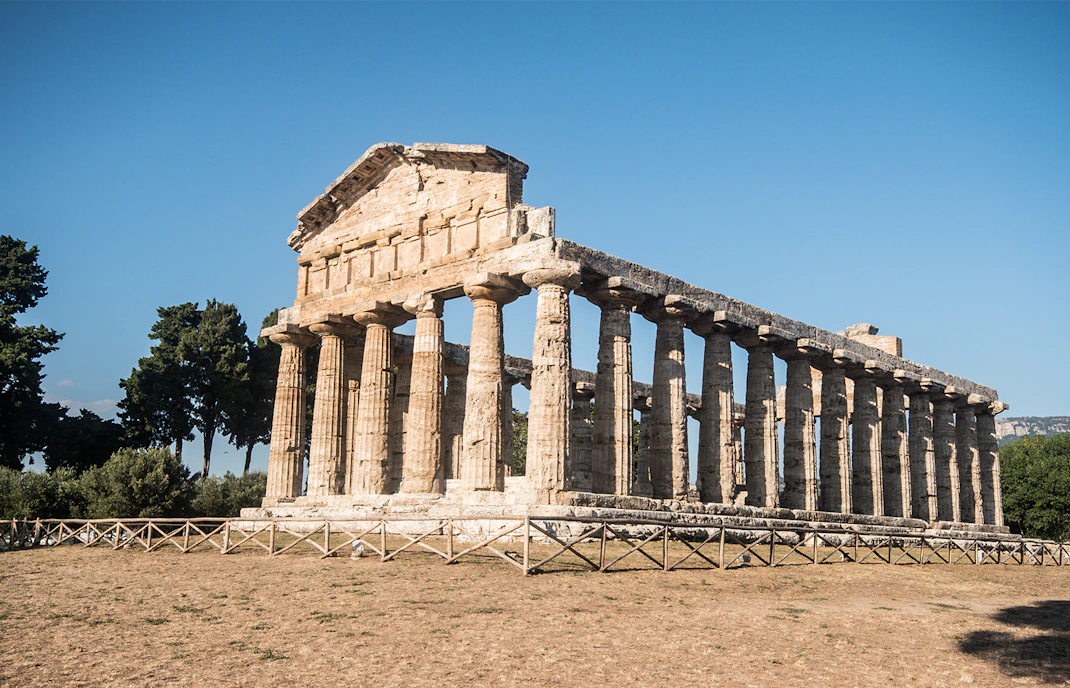
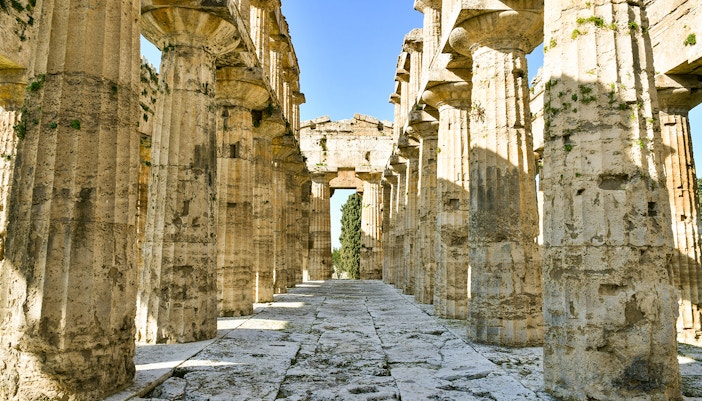
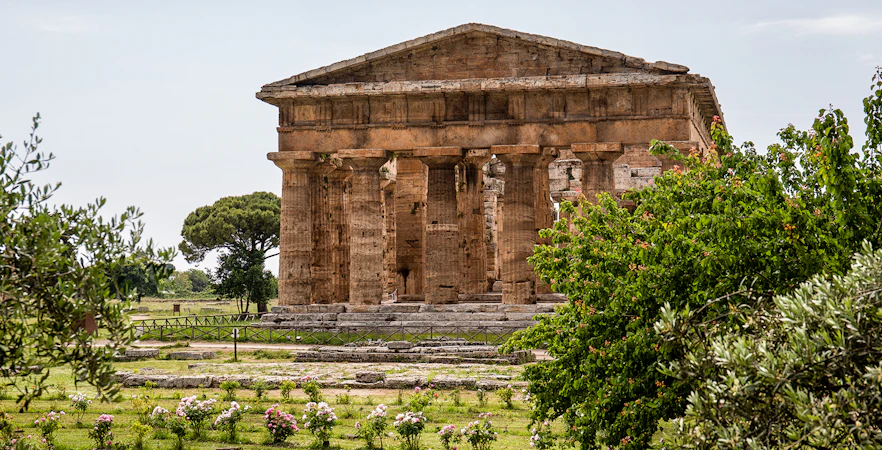
Built: around 450 BC The largest and most complete Doric temple surviving in the Mediterranean. All 36 outer columns and the entablature are intact, giving a rare sense of the original structure at full height. Stand at the southeast corner for the angle at which the three rows of columns align most clearly. Most visitors photograph the long south elevation and move on; slow down to walk the east portico instead, where the scale of the individual columns and the precision of the fluting is most apparent.
Where to find it: Immediately inside Porta Principale on the right.
Tomb of the Diver (National Archaeological Museum)
Dating: around 480 BC Five limestone slabs from a single painted tomb, now displayed as they would have been positioned. The ceiling panel, showing a diver in mid-air, is the only surviving complete example of Greek figurative painting from mainland Italy. The image is small and easily passed. Ask a museum attendant to point out the room if you can't locate it. Allow at least 10 minutes here.
Where to find it: National Archaeological Museum, ground floor, south gallery.
Temple of Hera I (the Basilica)
Built: around 550 BC The oldest temple at Paestum and one of the oldest surviving Doric temples anywhere. The 9 by 18 column plan is unusual for the period; most temples from this era have 6 by 13. The pronounced bulge (entasis) in each column is more exaggerated than in later structures and visible to the eye without technical knowledge. Arrive early for the best photographs without other visitors in the frame.
Where to find it: 200m south of the Temple of Neptune on the same axis.
Temple of Athena (Ceres)
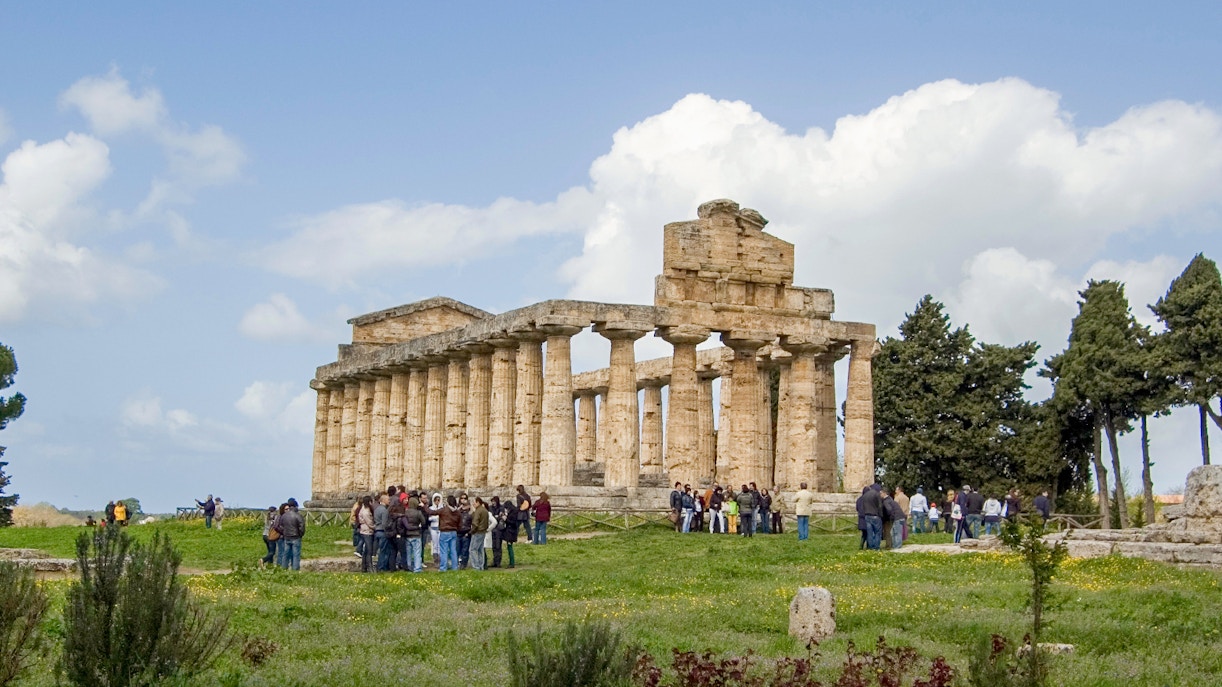
Built: around 500 BC The northernmost temple and the least visited of the three. It stands on a natural rise that gives a clear view south across the full site. In the porch area, traces of painted decoration survive on the ceiling blocks and are visible with patient looking.
Where to find it: Northern end of the site, around a 15-minute walk from Porta Principale.
The Amphitheater
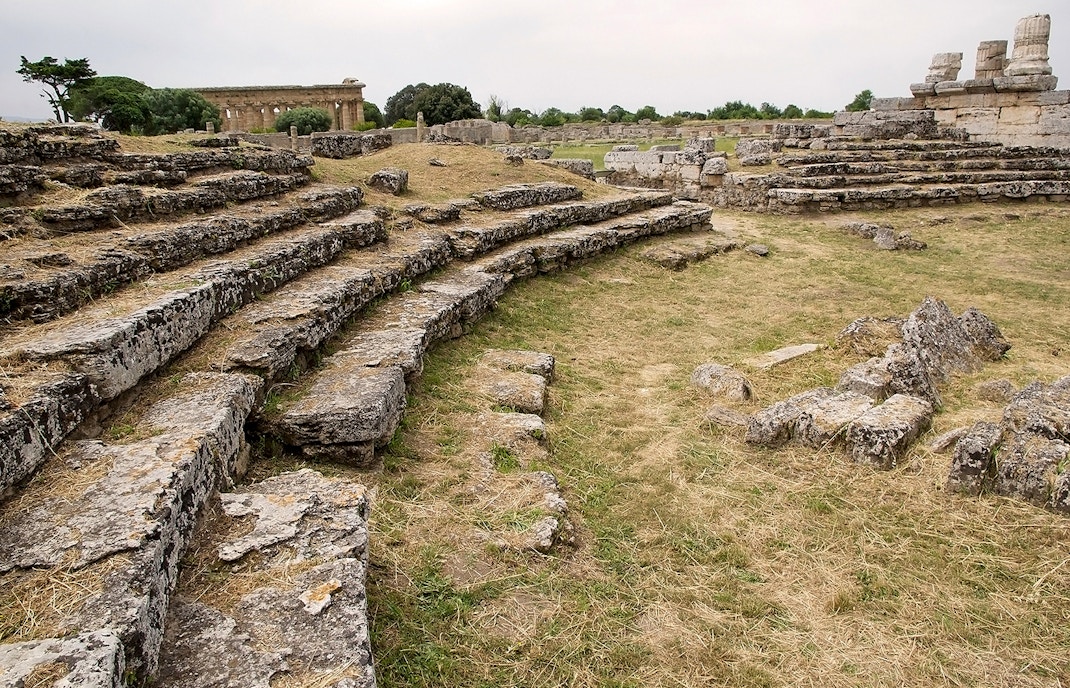
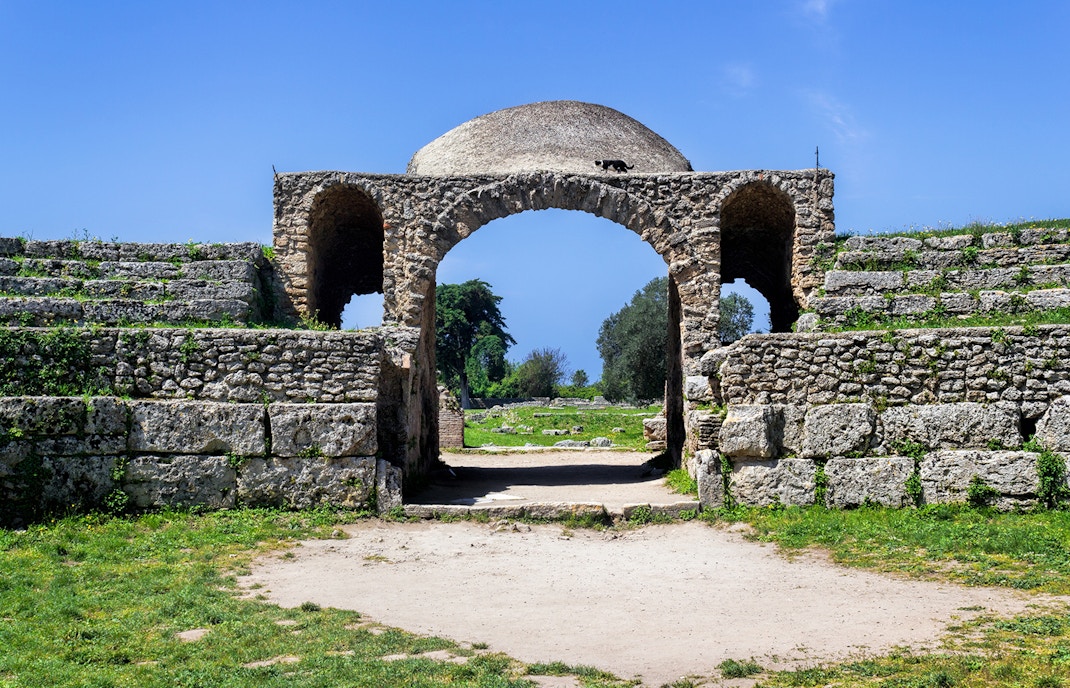
Built: 1st century BC under Roman rule Only the southern half of the amphitheater is visible; a 19th-century road was built over the northern section. The surviving arc of seating gives a clear sense of the capacity (approximately 20,000) and the arena floor level.
Where to find it: Center of the site, close to the Roman Forum.
Lucanian Painted Tomb Frescoes (National Archaeological Museum)
Dating: 4th–3rd century BC A sequence of painted limestone tomb slabs showing warriors on horseback, funerary processions and athletic competitions. Less well-known than the Tomb of the Diver and often overlooked in the rush to find it. The pigments are well-preserved.
Where to find it: National Archaeological Museum, north gallery, ground floor.
The view south from the Temple of Athena across the full archaeological site, with the two southern temples in line. Most visitors walk through this space without stopping because the temple itself is at the far end of the route.
Facilities and accessibility
Rules and restrictions
Practical tips
- Arrive at 8:30am from June through August. The site is completely exposed and the stone paths radiate significant heat from around 11am. Arriving at opening gives roughly 90 minutes of comfortable visiting before midday. Most visitors arrive between 10am and noon.
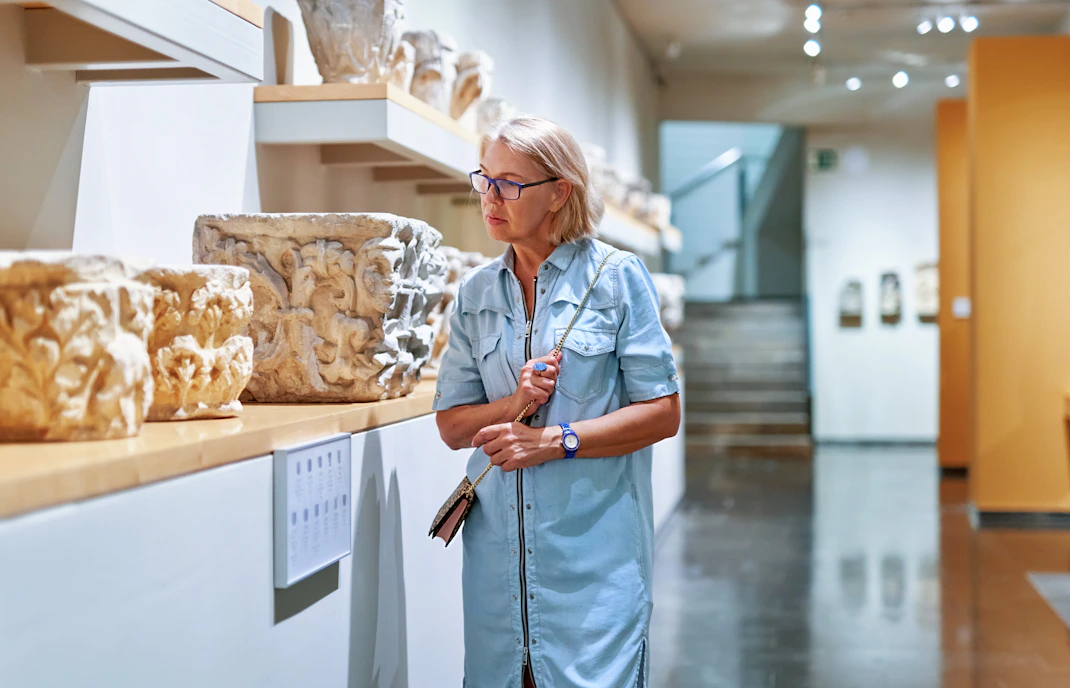
- Plan the museum visit separately from the temple circuit. It requires 45 to 60 minutes to cover properly, and the 1st and 3rd Monday closures at 1:40pm catch visitors who intend to fit it in at the end of a long afternoon.
- Weekday mornings in April and May can be busier than expected. School groups often arrive mid-morning and move through the main temple circuit as a group. Arriving at opening or visiting after 2pm avoids the overlap.
- Leave large bags at the Porta Principale cloakroom. The uneven stone paths between temples make large bags genuinely impractical, and the regulations prohibit them. Security does not systematically check, but the walk is easier without them.
- The train from Salerno (35 minutes) eliminates parking logistics and drops you a flat 10-minute walk from the main entrance along Via Magna Graecia. It is more practical than driving unless you plan to continue south into Cilento after your visit.
- Your ticket includes access to the Velia archaeological site, around 60km south. If you have a car and an extra day, combining both parks on a single 3-day ticket is very good value.
What else is worth visiting nearby?
Eat, shop and stay near Paestum
Frequently asked questions about visiting Paestum
The park is open daily from 8:30am to 7:30pm (current schedule through 21 September 2026). Last admission to the archaeological area is at 6:30pm; last admission to the museum is 7pm. On the 1st and 3rd Monday of each month, the museum closes at 1:40pm with last entry at 1pm. The park is closed on 25 December and 1 January. Check the official site for hours from October 2026 onward.
April, May and September offer the best combination of comfortable temperatures and manageable crowds. If visiting in July or August, arrive at 8:30am; the site is fully exposed and midday heat is the main difficulty, not queues. Weekday mornings from April to June are the quietest windows, though school groups can arrive mid-morning.
Most visitors spend 2 to 3 hours on the temple circuit. Add 45 to 60 minutes if you include the museum. A thorough visit including the Roman Forum and Amphitheater takes 4 to 5 hours. The ticket is valid for 3 days, so you can split the visit if time is short.
Standard walk-up admission is €15 from March to November and €10 from December to February. Under-18s and young people aged 18 to 25 enter free. The ticket includes access to the museum and to the Velia archaeological site and is valid for 3 consecutive days. Guided tours with priority access start from €39.50 via Headout.
No advance booking is required for standard entry. Tickets can be purchased at the Porta Principale ticket office or at the museum entrance from 8:30am to 6:30pm. Guided tour places via Headout are limited and recommended to book at least a few days ahead from June through August.
The park is at Via Magna Graecia, 919, 84047 Capaccio SA, Italy. It is approximately 100km south of Naples and 38km south of Salerno. Paestum train station is a 10-minute walk from the main entrance.
The train is the most practical option from both Naples (around 1 hour 30 minutes) and Salerno (around 35 minutes). Trenitalia regional services stop at Paestum station, a 10-minute flat walk to the main entrance. CSTP bus 34 also connects Salerno with Paestum in around 60 minutes.
The main visitor entrance (Porta Principale) is near the Temple of Neptune on Via Magna Graecia. Tickets can also be bought and entry made at the National Archaeological Museum entrance. Porta Cerere is available as an additional entry point for visitors who already hold a valid ticket. The four ancient gates in the city walls (Porta Aurea, Sirena, Giustizia and Marina) are historical features within the park and are not visitor entrances.
Yes. The ticket is valid for 3 consecutive days and allows re-entry to both the archaeological site and the museum within that window (one entry to each per day).
The National Archaeological Museum is fully accessible with ramps and lifts. The archaeological site has an accessible path running north to south, giving access to the Basilica (Temple of Hera I). For areas beyond the accessible path, the site offers ZOOM UPHILL, a free electric off-road vehicle for visitors with mobility difficulties. Visitors with disabilities and their accompanying person receive free entry. Ask at the Porta Principale ticket office on arrival.
Prams are not advisable for the archaeological site; the ground between temples is uneven stone. A lightweight stroller is more manageable and can access the main accessible path. The museum interior is smooth and stroller-friendly throughout.
Yes, amateur photography is permitted throughout the site and archaeological area. Inside the National Archaeological Museum, flash photography is not permitted. Drones require prior written authorization from site management. Professional or commercial photography also requires advance authorization.
Yes. A cloakroom is available at the Porta Principale ticket office. Visitors can deposit backpacks, bags and luggage here before entering. Large bags are not permitted on site.
No. Food and drinks are not permitted inside the park or the museum. Several restaurants are within 500 to 650m of the main entrance.
There is no specific dress code. The official site recommends wearing flat, comfortable shoes; the archaeological site involves uneven stone paths throughout. For summer visits, bring a hat and sunscreen as the site has minimal shade.
Dogs are permitted in the archaeological area on a leash and with a muzzle, but must not approach monuments. Small pets in a carrier are permitted in the museum. Guide dogs are always permitted throughout the site and museum. Note that stray dogs have been reported in the surrounding area.